Novel method for early determination of alzheime’s disease – María Teresa Martín Correa
Novel method for early determination of alzheimer’s disease – María Teresa Martín Correa
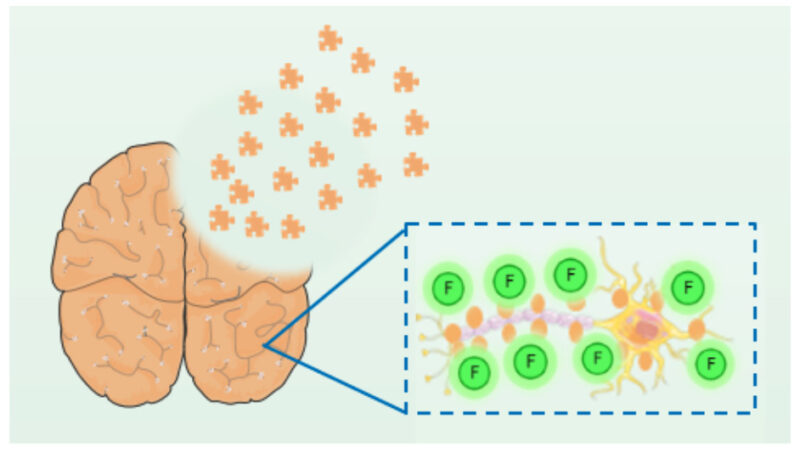
Alzheimer’s disease is a very common neurodegenerative disease today. This brain disorder slowly destroys the memory, the ability to think and, over time, the hability to perform even the simplest tasks. Despite the many studies carried out on the disease due to its severity, not we still do not know all the molecular, genetic and biochemical mechanisms causing it are knownthat can trigger it. However, it is knownwe do know that proteins called β-amyieloids accumulate in the form of plaques on the outside of the neurons of the patients with Alzheimer’s, being greaterand that the accumulation of this protein increases as the diasease progresses and the symptomns are aggravatedbecome more serious.
Based on the above, experiments were conducted with a fluorescent synthesis compound capable of binding β-amyieloids proteins with high affinity. The intensity of light emitted by the compound is higherbecomes more intense by increasingwhen the concentration of the protein to which it binds is increased, even at low concentrations of protein., which This allows an early diagnosis of Alzheimer’s disease by indicating the number of plaques presented by the patient at the time of the study., which allows to address aEarly diagnosis enables better treatment of the disease.
Keywords: Alzheimer’s, β-amyieloids plaques, fluorescent compound, early diagnosis.
Directed by: Luis Crovetto González
Study of cells by fluorescence – Elena Villegas García
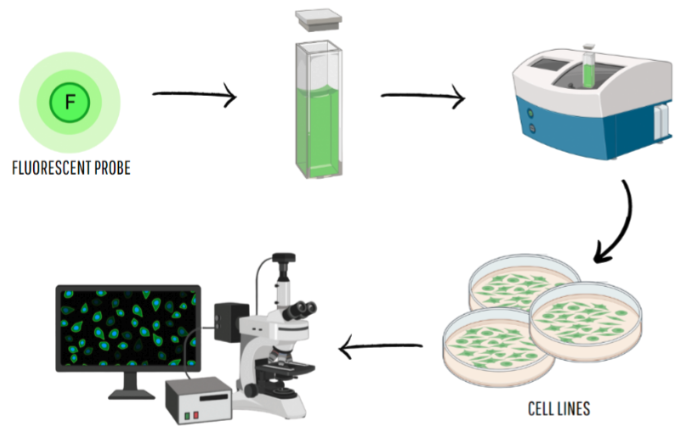
Fluorescent probes are molecules that emit light when they receive excess energy. This emission of light is known as fluorescence and has interesting applications in the treatment and/or diagnosis of different diseases. If we can make these fluorescent probes bind to human cells that are only present in one particular disease, we will be able to diagnose that disease more effectively.
In my Master’s thesis I am working on a fluorescent probe similar to other existing ones. Previous research on other fluorescent probes shows that they have an affinity for specific substances present in our body cells. The purpose of my work is to investigate which substance the probe I am working with can bind to. To do this, we will build on the results obtained in previous experiments with other similar fluorescent probes.
But what could be the first step? Cell lines.
Cell lines are uniform cell cultures that are easy to obtain in the laboratory in large numbers. In this study we are going to use healthy cell lines that allow us to analyse and discover to which substances or compounds in the cells our molecule is able to bind. Once we have this information, we will be able to advance in this research and study the application of this molecule in the diagnosis or even treatment of diseases, since depending on the cellular compound to which it binds, we will be able to screen for diseases in which this compound is overexpressed, so identifying the maximum functionality of the molecule.
Keywords: fluorescence, fluorescent probes, cell lines, diagnosis.
Directed by: Luis Crovetto González