• Skip to primary navigation
  • Skip to main content
  • Skip to primary sidebar

Divulgando ciencia

Máster en Investigación, Desarrollo, Control e Innovación de Medicamentos

  • Home
  • Presentation
  • Curses
    • 2022/2023
    • 2021/2022
    • 2020/2021
  • Category
    • Biotechnological drugs
    • Chemical drugs
    • Diagnostics
    • Cosmetics
    • Genetics
    • Immunology
    • Microbiology
    • Nanotechnology
    • Pharmaceutical technology
    • Probiotics
  • Links of interest
  • Privacy Policy
You are here: Home / Archives for Anabel Torrente

Are environmental conditions harmful for biological drugs? – Alejandro Martín Rodríguez

15 May, 2023 por Anabel Torrente Leave a Comment


When we get ill or suffer from a disease, we go to the doctor in search of a treatment that will make us better. With rare diseases, biotechnological drugs are used as treatments because they are more effective than their chemical counterparts. Biotechnological drugs are based on therapeutic proteins that are specifically designed to treat a particular illness. However, they tend to be more fragile and unstable than chemical ones. They can suffer alterations during the production phase and during shipping. 

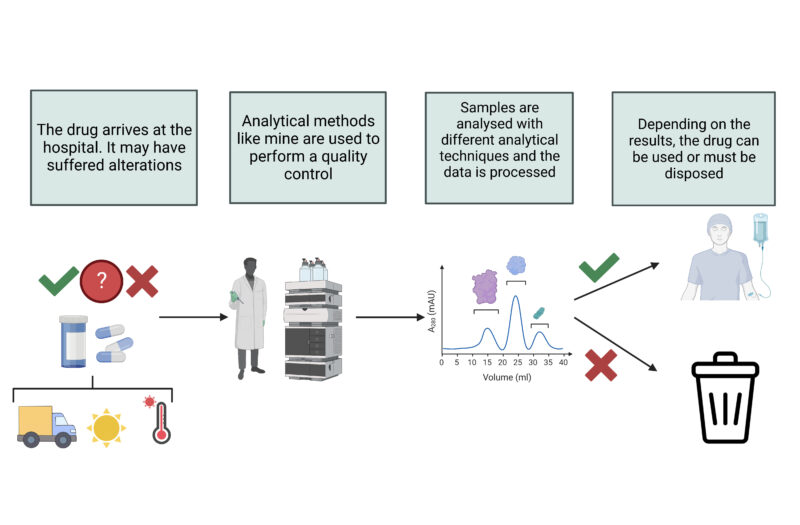
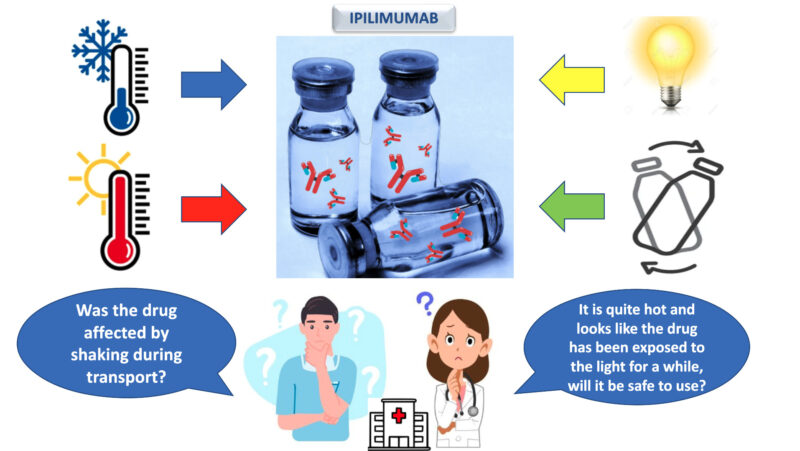
They are more sensitive to environmental conditions such as exposure to the sun, temperature changes and brusque movements (for example during transport). Conscientious quality control is therefore essential before administration to the patient. 

My Master’s project focuses on the quality control of Ipilimumab, a therapeutic protein used in hospitals for treating melanomas and colorectal cancers among others. The method I apply involves subjecting the drug to controlled stress conditions, such as extreme temperatures, freezing, stirring, etc. I then compare the data obtained from the stress tests with the data for an unstressed control sample. The data are obtained using analytical techniques such as Liquid Chromatography.  

In this way, recommendations can be made regarding the correct handling of this drug, and we can avoid using it if it shows signs of degradation. 

Keywords: Therapeutic proteins- Environmental conditions- Quality control- Analytical techniques 

Directed by: Natalia África Navas Iglesias 
Filed Under: 2022/2023, Biotechnological drugs

Stability analysis of ipilimumab, a drug used to treat cancer – Alberto Aguilera Ortega

15 May, 2023 por Anabel Torrente Leave a Comment


Cancer is one of the main causes of death in the world today. It is a disease involving body cells that have become immortal, so enabling them to grow rapidly, accumulate, and even invade other areas of the body. 

Ipilimumab is a drug designed to treat cancer. It is an antibody that recognises a protein (called CTLA-4) in the human body, so boosting our immune system’s ability to destroy cancer cells. 

These types of medicines have very high costs for healthcare systems and are usually administered in hospitals. Safe handling of these medicines in the hospital is an important issue, because as proteins they are very sensitive to the conditions to which they may be exposed during handling, storage or transport. For all these reasons, in this research we studied the stability of ipilimumab and its activity when subjected to a range of conditions that can arise in hospital settings, such as shaking, an increase in temperature or light exposure. In this way, we can provide healthcare professionals with the necessary information for the proper handling of ipilimumab, so as to ensure its safety and efficacy. Furthermore, the high price and the short stability of these drugs for administration to patients (around 24h) leads to the generation of many leftovers which, if studied using different analytical approaches, could be reused in a safe and effective way. Research of this kind could therefore create direct savings for the Public Health System and perhaps increase the number of treatments with these drugs. 

Keywords: Cancer, drug, ipilimumab, stability. 

Directed by: Natalia África Navas Iglesias 
Filed Under: 2022/2023, Biotechnological drugs

New combined drugs: antibiotic + anti-inflammatory – Ana Cruz Muñoz

15 May, 2023 por Anabel Torrente Leave a Comment

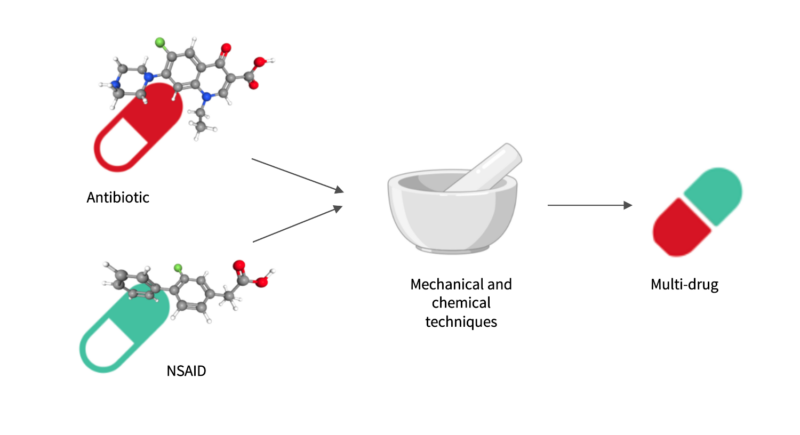
Most drugs on the market have properties that could be improved, of which solubility is the most common. Solubility is important because it affects absorption, that is, the amount of drug that enters the body. Low absorption means that the drug cannot reach its destination and does not have sufficient effect. If this happens, the dose must be increased, so raising not only the costs of the treatment but also the side effects. Various different techniques can be applied to solve this problem, one of which involves binding the drugs to other molecules that improve the solubility of the drug without affecting its action. Sometimes, these molecules can be other drugs, so that in addition to improving the properties, we can create a “multi-drug” that is very useful in combination therapies. 

The aim of the study is to combine two drugs: an antibiotic and a non-steroidal anti-inflammatory drug (NSAID), such as flurbiprofen. To this end, we carried out mechanochemical syntheses, such as grinding, which enable the formation of bonds between the two drugs, giving rise to salts. Once we had obtained the drug-drug salts, we then conducted characterization, stability and solubility studies on them to assess their viability. 

Keywords: antibiotic, anti-inflammatory, solubility, absorption, multidrug. 

Directed by: Alicia Domínguez Martín 

Filed Under: 2022/2023, Chemical drugs.

Novel method for early determination of alzheimer’s disease – María Teresa Martín Correa

15 May, 2023 por Anabel Torrente Leave a Comment


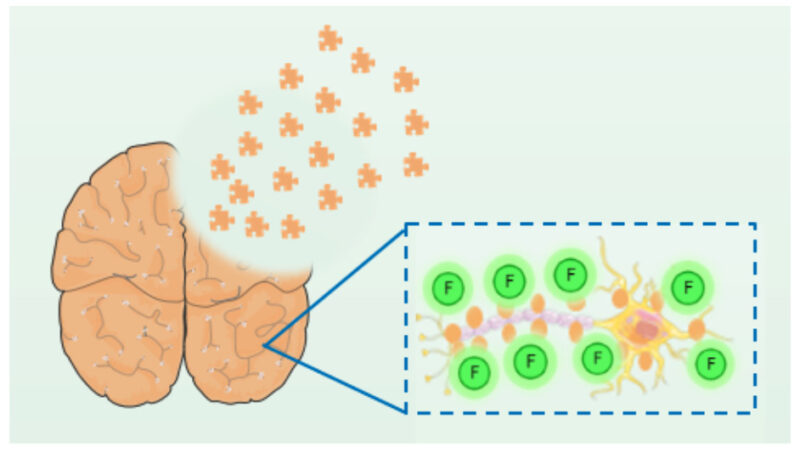
Alzheimer’s disease is a very common neurodegenerative disease today. This brain disorder slowly destroys the memory, the ability to think and, over time, the hability to perform even the simplest tasks. Despite the many studies carried out on the disease due to its severity, not we still do not know all the molecular, genetic and biochemical mechanisms causing it are knownthat can trigger it. However, it is knownwe do know that proteins called β-amyieloids accumulate in the form of plaques on the outside of the neurons of the patients with Alzheimer’s, being greaterand that the accumulation of this protein increases as the diasease progresses and the symptomns are aggravatedbecome more serious. 

Based on the above, experiments were conducted with a fluorescent synthesis compound capable of binding β-amyieloids proteins with high affinity. The intensity of light emitted by the compound is higherbecomes more intense by increasingwhen the concentration of the protein to which it binds is increased, even at low concentrations of protein., which This allows an early diagnosis of Alzheimer’s disease by indicating the number of plaques presented by the patient at the time of the study., which allows to address aEarly diagnosis enables better treatment of the disease. 

Keywords: Alzheimer’s, β-amyieloids plaques, fluorescent compound, early diagnosis.

Directed by: Luis Crovetto González 

Filed Under: 2022/2023, Diagnostics

Evaluation of the quality of talcum powder marketed in Morocco for pharmaceutical-cosmetic use – Ayyoub Selmaoui Khayali

15 May, 2023 por Anabel Torrente Leave a Comment


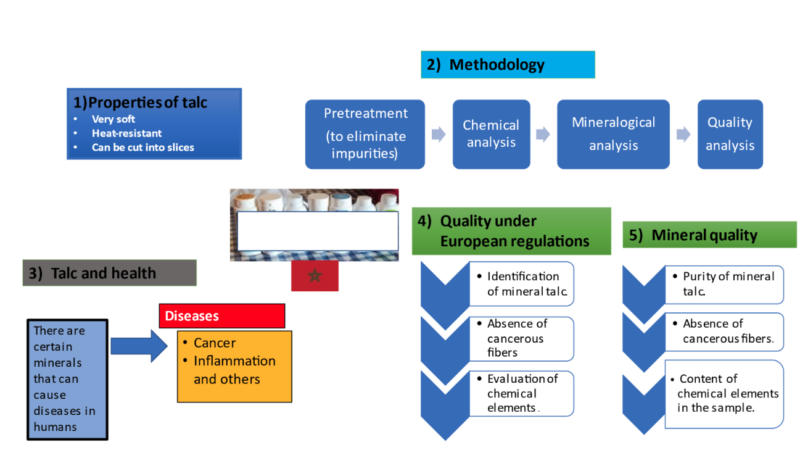
Talc is a raw material whose mineralogical origin is related to other types of soils and minerals such as quartz, magnesite and serpentine. 

Talc is widely used in industries such as textiles, paper, food and ceramics and especially in the pharmaceutical industry. This is why exhaustive quality and safety controls are carried out on the mineralogical and chemical composition of the product. 

This sparked my interest in studying the mineralogical and chemical composition of talc samples from Morocco in 2022 for pharmaceutical-cosmetic use. The quality guidelines established in European regulations have been followed in order to assess the suitability of the samples with a view to their possible introduction into the European market. 

Keywords: talc, mineral quality, pharmaceutical-cosmetic, Morocco.

Directed by: María Virginia Fernández González 

Filed Under: 2022/2023, Cosmetics

  • Page 1
  • Page 2
  • Page 3
  • Interim pages omitted …
  • Page 9
  • Go to Next Page »

Primary Sidebar

  • English
  • Español

Tweets

Meta

  • Log in
  • Entries feed
  • Comments feed
  • WordPress.org

Universidad de Granada
blogsUgr
C.S.I.R.C. · Plataformas webs corporativas
Log in

We are using cookies to give you the best experience on our website.

You can find out more about which cookies we are using or switch them off in .

Divulgando ciencia
Powered by  GDPR Cookie Compliance
Privacy Overview

This website uses cookies so that we can provide you with the best user experience possible. Cookie information is stored in your browser and performs functions such as recognising you when you return to our website and helping our team to understand which sections of the website you find most interesting and useful.

Strictly Necessary Cookies

Strictly Necessary Cookie should be enabled at all times so that we can save your preferences for cookie settings.

Analytics

This website uses Google Analytics to collect anonymous information such as the number of visitors to the site, and the most popular pages.

Keeping this cookie enabled helps us to improve our website.

Cookie Policy

More information about our Cookie Policy