• Saltar a la navegación principal
  • Saltar al contenido principal
  • Saltar a la barra lateral principal
  • Saltar al pie de página
  • Home
  • Students’ World
    • Erasmus Experiences
    • Improve your English
  • Professors Beyond the Classroom
    • Interviews
  • Events
    • Agenda
    • Lectures’ Articles
    • Cultural Events
  • Off Campus
    • Suggested Readings
    • Let’s go to the movies
    • Recipes
      • Christmas Recipes Special
  • Contacto

the philologist /UGR/

  • El blog de los estudiantes del Departamento de Filologías Inglesa y Alemana de la Universidad de Granada
Usted está aquí: Inicio / Archivo de Escocia

New Year’s Eve and New Year’s Day Traditions

31 diciembre, 2016 por Corpus Delicti Deja un comentario

Hello everyone! Today is New Year’s Eve and the year 2017 is just about to begin! I am sure most of you will follow various Spanish traditions tonight, but… Aren’t you curious about how people celebrate these special days in Scotland, England, Wales, Ireland or Germany, for instance?

We looked for information and asked some abroad students too, who told us about the most unique traditions and superstitions in their countries. So, if you are interested, continue reading 😉

Scotland

In Scotland, The New Year’s Eve is known as ‘Hogmanay’. The name comes from a kind of oatcake that was typically given to children on New Year’s Eve.

On this day, many people would choose to spend the night with friends or family. Also, in Edinburgh, a festival is celebrated typically from the 28th of December to the 2nd of January. On the night of the 31st of December a huge party takes place in the city, the Edinburgh Castle’ cannon would be fired at the stroke of midnight, followed by a spectacular fireworks display. They would typically sing the ‘Auld Lang Syne’ (The good old days) based on a poem by the Scottish writer Robert Burns in 1788.

[1] ‘Auld Lang Syne’
[1] ‘Auld Lang Syne’

From midnight on, the tradition of ‘first footing’ takes place. Scottish people have various superstitions as they believe the first person to cross their home threshold would determine the fate of the people living there for the new year. Typically, a dark haired man or a stranger would bring good luck. First footers would also bring gifts such as a coin or salt representing prosperity, bread, for food, coal for warmth or whisky to represent cheer, and in many places people would wish one another ”Lang may your lum reek” (hope your chimney will smoke for a long time).

[2] ‘First footing’
[2] ‘First footing’

England

In England, the New Year’s Eve is not widely celebrated as Christmas but some traditions are still observed. Some people would celebrate the end of the year with their family and friends and others would go to parties, pubs or clubs, especially the young people.

As a fairly recent tradition they would celebrate a big party in London. On TV, they would forecast one of the four clocks on the Clock Tower of the Palace of Westminster to count down the last seconds of the year, and afterwards, they would kiss at 12 o’clock, toast with champagne or sparkling wine and have fireworks or watch the fireworks taking place in London on TV. They would also do resolutions for the New Year.

[3] Fireworks in London
[3] Fireworks in London

More traditionally, at the stroke of midnight, people would open the back door to let the bad things and the old year out and, in some parts of England, the tradition of first footing also takes place. They would ask the first black haired man to cross the door and the visitors would leave the house using the back door for good luck.

On New Year’s day, the celebrations in London would continue with a huge New Year’s Day parade and most people would typically have a ‘roast dinner’ with their family: meat, vegetables, potatoes and maybe a special dessert and would watch special editions of popular TV programs and programs reviewing the last year.

While some begin the year in such a quiet way, in many coastal towns (in England and other parts of the United Kingdom, as well as in Ireland) people have the tradition to go to the sea at the morning for a New Year’s Day swim! Some may even wear fancy costumes!!

[4] New Year's Day swim
[4] New Year’s Day swim
[5] New Year's Day swim
[5] New Year’s Day swim

Wales

In Wales, the New Year’s Eve is called ‘Nos Galan’.

Many celebrations take place at Cardiff castle and Cardiff City Hall, they have fireworks, live music and organise fun-fairs and many other activities.

The tradition of first footing is also typical. It is considered that if the first footer is a woman and a man opens the door is considered bad luck, and if the first footer to cross the threshold in the New Year is a red head, it also represents bad luck.

Another interesting belief is that you should pay all your debts before the New Year begins, and if you don’t do this, it would mean a whole new year of debt!

[6] To-do-list
[6] To-do-list

On New year’s day, called ‘Dydd Calan’, children would get up early to visit their neighbors and sing songs. They would typically be given coins, mince pies, and sweets for singing. This tradition of giving gifts and money is called ‘Calennig‘. Here you can listen to a typical Calennig rhyme!


Ireland

In Ireland, the New Year’s Eve is called ‘Oíche Chinn Bliana’ and the New Years day is known as ‘Lá Caille’ or ‘Lá Bliana Nua’.

Also in Ireland, many people go to dinners and parties in private homes, pubs or clubs for New Year’s Eve. At the stroke of midnight there may be fireworks and music to celebrate the beginning of the New Year. Then, New Year’s Day parades are held in many towns and cities on the 1st of January. A large parade is held in Dublin.

As an old tradition, people would clean their homes, put fresh sheets on their beds, and stock up on food and other household supplies. They believe this would bring them good luck, and a fresh and prosperous start to the New Year.

[7] Cleaning for the new year
[7] Cleaning for the new year

Another funny tradition is that at the stroke of midnight they would bang on the walls and doors of the house with Christmas bread to chase the bad luck out of the house and invite the good spirits in.

[8] Irish Christmas bread or ‘banging bread'
[8] Irish Christmas bread or ‘banging bread’

In some parts, the tradition of first footing is also considered to make predictions for the New Year’s fate and visitors would typically enter the front door and leave the house using the back door for good luck. Also, New year’s dips are organized in coastal towns in Ireland, that is, short swims in the cold waters early at the morning, as in other parts of the United Kingdom (so cold!)

Germany

Finally we turn to Germany, where New Year’s Eve is called ‘Silvester’.

Many parties are held too around the country, but most typically people would invite friends and family to have dinner together at home, for instance many people would eat ‘Raclette’ for dinner and afterwards, they would typically play some board games and funny games for forecasting the future such as distributing fortune cookies or the most typical one called ‘Bleigießen’. They would melt small quantities of lead on a silver spoon above a candle, and they would introduce then the molten lead into a bowl of cold water where it solidifies. Then, they would interpret the shape that the lead finally takes as a symbol for the fortunes of the coming year.

[9] ‘Bleigießen’
[9] ‘Bleigießen’

They would also watch special programs, films and sketches that are broadcast every year. A must-do is to watch the short clip ‘Dinner for one’, a British black and white movie, famous for being the most frequently repeated TV programme ever.

At midnight, people would cheer with sparling wine saying ‘Prost Neujahr’ (informal), do their new year’s resolutions and they would have fireworks afterwards.

Hope you enjoyed reading about these unique traditions!! Make sure you follow some of these to avoid bad luck for the coming year 😉

Spend a great night and Happy New year everyone!!


References:

https://www.timeanddate.com/holidays/

http://www.learnenglish.de/culture/newyear.html

https://www.youtube.com/watch?v=ansvP-F0C4Q

Contributors who told us about their traditions:

Claudia (Jena, Germany); Emilie (Cambridge, England); John (Nottingham, England); Emyr (Aberystwyth, Wales).

Pictures taken from:

[1] http://artynews.com/auld-lang-syne/

[2] http://www.kit-handford-ceremonies.co.uk/gallery.html

[3] http://www.londonlifestyleawards.com

[4] / [5] http://www.dailymail.co.uk/news/article-3381182/Come-water-s-freezing-Swimmers-brave-icy-sea-traditional-New-Year-s-Day-swims-country-pets-joining-in.html#ixzz4UPfTjgbb

[6] http://stevewelker.ca/2015/05/29/paying-off-debt/

[7] http://ireland-calling.com/irish-new-year-traditions/

[8] http://magazine.foxnews.com/food-wellness/new-years-foods-around-world

[9] http://www.vienayyo.com/¡bleigiesen-por-fin-de-ano/

Author: A.R.G.

Editor: E.R.S.
Publicado en: Cultural Events Etiquetado como: Alemania, Deirdre Madden, England, Escocia, Gales, Germany, Inglaterra, Ireland, New Year's Day, New Year's Eve, Nochevieja, Scotland, Tradition, Wales

SCOTLAND (UK): Scottish Shortbread / Galletas de mantequilla (en inglés)

18 diciembre, 2016 por Corpus Delicti Deja un comentario

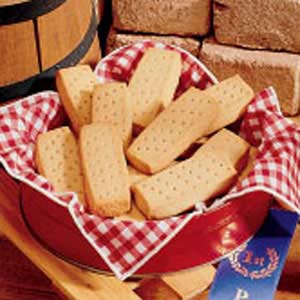
Today’s special recipe comes from Ana Díaz Negrillo, professor of the Department of English and German, and it is a Scottish Shortbread. It brings a very informative introducction so we can learn a little bit about Scotland’s culture and history. What are you waiting? Keep on reading!

scottish_shortbread_1325

Scottish cookery has always differed from culinary endeavours south of the Border. The Romans influenced English cooking but as they did not venture far into Scotland, historically Scottish cuisine developed slowly. Scottish cooking methods advanced through the influence of the French at the court of Mary Queen of Scots and later through the elaborate dishes served to English lords with Scottish estates. Queen Victoria and Prince Albert acquired Balmoral in the 19th century and whilst they brought with them the rich food of the English court, they also liked to serve traditional Scottish dishes to important visitors.

Scottish cooks have always been famous for their soups, haggis (a dish traditionally served on Burns Night) and their baking, especially scones, pancakes, fruit cakes, oatcakes and shortbread.

The story of shortbread begins with the medieval «biscuit bread». Any leftover dough from bread making was dried out in a low oven until it hardened into a type of rusk: the word «biscuit» means «twice cooked». Gradually the yeast in the bread was replaced by butter, and biscuit bread developed into shortbread.

Shortbread was an expensive luxury and for ordinary people, shortbread was a special treat reserved just for special occasions such as weddings, Christmas and New Year. In Shetland it was traditional to break a decorated shortbread cake over the head of a new bride on the threshold of her new home. The custom of eating shortbread at New Year has its origins in the ancient pagan Yule Cakes which symbolised the sun. In Scotland it is still traditionally offered to «first footers» at New Year.

Shortbread has been attributed to Mary, Queen of Scots, who in the mid-16th century was said to be very fond of Petticoat Tails, a thin, crisp, buttery shortbread originally flavoured with caraway seeds.

There are two theories regarding the name of these biscuits. It has been suggested that the name «petticoat tail» may be a corruption of the French petites gatelles («little cakes»).

However these traditional Scottish shortbread biscuits may in fact date back beyond the 12th century. The triangles fit together into a circle and echo the shape of the pieces of fabric used to make a full-gored petticoat during the reign of Elizabeth I. The theory here is that the name may have come from the word for the pattern which was ‘tally’, and so the biscuits became known as ‘petticoat tallis’.

Shortbread is traditionally formed into one of three shapes: one large circle divided into segments («Petticoat Tails»); individual round biscuits («Shortbread Rounds»); or a thick rectangular slab cut into «fingers».


Ingredients:

  1. 200g/7oz unsalted butter, at room temperature, cut into small cubes
  2. 100g/3½oz sugar, plus extra for sprinkling
  3. 1 tsp vanilla extract
  4. 300g/10½oz plain flour, sifted, plus extra for dusting

Directions:

  1. Preheat the oven to 160C/325F/Gas 3.
  2. Mix together the butter and sugar, either by hand or using an electric hand whisk, until pale and smooth. Add the vanilla extract, then gently mix in the flour until completely incorporated (try not to work the flour too much or the biscuits will not be so crumbly). Using your hands, squeeze the mixture together into a ball of dough.
  3. Gently roll the dough out to about 5mm/¼in thick (dust the work surface with a little flour if the dough sticks). Cut into shapes using a biscuit cutter. Transfer the biscuits to a baking tray lined with baking parchment (or a non-stick baking tray) and chill in the fridge for 15 minutes to rest (chilling makes them hold their shape better when baking).
  4. Before cooking, sprinkle each biscuit with a pinch of granulated sugar. Bake in the preheated oven for 15-20 minutes, or until pale golden-brown.
  5. Remove from the oven and transfer the biscuits to a wire rack to cool.

Enjoy!

Sent by: Ana Díaz Negrillo

Source: http://www.bbc.co.uk/food/recipes/butter_shortbread_74896

Image: http://cookdiary.net/scottish-shortbread/

Editors: C.L.C., E.R.S.

Publicado en: Christmas Recipes Special, Recipes Etiquetado como: Christmas, Escocia, galletas de mantequilla, Navidad, Queen Victoria, Receta, Recipe, Reino Unido, Scotland, Scottish cookery, Scottish Shortbread, Shortbread, UK

Preview! Christmas Recipes Special / Especial recetas de Navidad

16 diciembre, 2016 por Corpus Delicti Deja un comentario


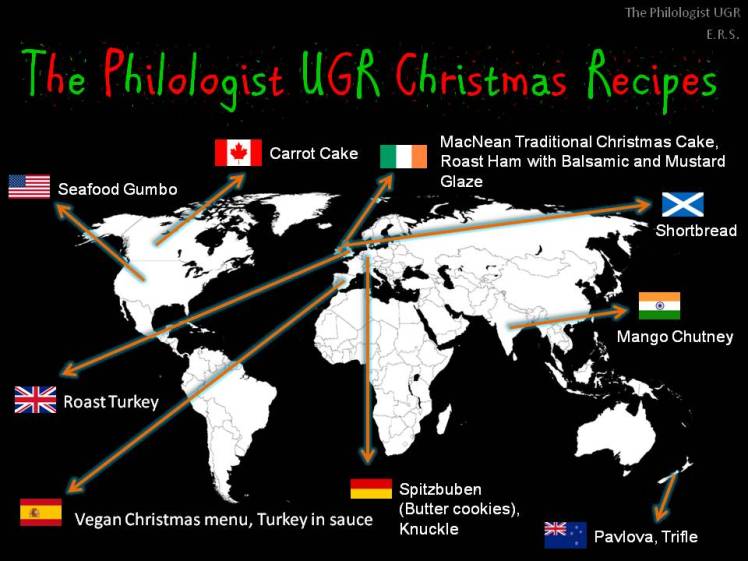
christmas-recipes

Do you like any of these recipes?

Do you know all of them?

Do you need some ideas for Christmas?

From December 17 and until December 24 you will find one or two of these recipes each day.

A whole week of Christmas recipes from English/German-speaking countries.

These recipes have been sent to us by both professors and students.

And they are not the totality of the recipes…

There is more to come…

Stay alert!

Editor and image: E.R.S.


Sources images:

Map: http://www.imagui.com/a/mapamundi-en-blanco-png-czEaoxddK

Flags: http://www.banderas-mundo.es/descargar

Scotland flag: https://pixabay.com/es/escocia-bandera-aspa-891914/

Publicado en: Christmas Recipes Special, Recipes Etiquetado como: Alemania, Canada, Christmas, EE.UU., Escocia, España, Especial Navidad, Germany, India, Ireland, Irlanda, Navidad, New Zealand, Nueva Zelanda, Receta, Recipe, Reino Unido, Scotland, Spain, UK, USA

Barra lateral principal

  • Correo electrónico
  • Facebook
  • Twitter
  • YouTube

SUSCRÍBETE A the philologist

Recibe notificaciones por email de las nuevas entradas en el blog

Categorías

  • Becas y Ayudas (7)
  • Events (64)
    • Agenda (32)
    • Cultural Events (50)
      • PREMIO POESÍA the philologist /UGR/ (1)
    • Lectures' Articles (6)
  • Off Campus (70)
    • Culture Vulture (4)
    • Let's go to the movies (15)
    • Music (6)
    • Recipes (16)
      • Christmas Recipes Special (16)
    • Suggested Readings (18)
    • TV Series (9)
  • Poesía (5)
  • Professors Beyond the Classroom (10)
    • Interviews (4)
    • La tertulia profesor/a – alumno/a (1)
    • News (4)
  • Sin categoría (18)
  • Students' World (36)
    • Alumni (6)
    • Erasmus Experiences (5)
    • Exams (1)
    • Improve your English (7)
    • TFG (3)
  • Uncategorized (7)
junio 2026
L M X J V S D
1234567
891011121314
15161718192021
22232425262728
2930  
« Mar    

Follow us on Tweeter

Footer

Meta

  • Acceder
  • Feed de entradas
  • Feed de comentarios
  • WordPress.org

Universidad de Granada
blogsUgr
C.S.I.R.C. · Plataformas webs corporativas
Acceder

En BlogsUGR utilizamos cookies propias con finalidad técnica y para personalizar su experiencia de usuario. Algunos blogs de BlogsUGR pueden utilizar cookies de terceros para fines analíticos.


Puede aprender más sobre qué cookies utilizamos o desactivarlas en los .

the philologist /UGR/
Powered by  GDPR Cookie Compliance
Resumen de privacidad

BlogsUGR utiliza cookies propias para que podamos ofrecerte la mejor experiencia de usuario posible. La información de las cookies se almacena en tu navegador y realiza funciones tales como reconocerte cuando vuelves a BlogsUGR, haces algún comentario o seleccionas el idioma de un blog. Rechazar las cookies propias podría suponer la imposibilidad de acceder como usuario a BlogsUGR.

Algunos blogs de BlogsUGR utilizan cookies de terceros con fines analíticos para recabar estadísticas sobre la actividad del usuario en dicho blog y la actividad general del  mismo.

Cookies estrictamente necesarias

Las cookies estrictamente necesarias tiene que activarse siempre para que podamos guardar tus preferencias de ajustes de cookies.

Cookies de terceros

Algunos blogs de BlogsUGR utilizan Google Analytics para recopilar información anónima tal como el número de visitantes del sitio, o las páginas más populares.

Dejar esta cookie activa nos permite mejorar nuestra web.

También algunos blogs de BlogsUGR utilizan cookies de twitter.com que se utilizan para la visualización de esta red social en el blog.

Política de cookies

La presente política de cookies tiene por finalidad informarle de manera clara y precisa sobre las cookies que se utilizan en los blogs del servicio BlogsUGR de la Universidad de Granada.

¿Qué son las cookies?

Una cookie es un pequeño fragmento de texto que los sitios web que visita envían al navegador y que permite que el sitio web recuerde información sobre su visita, como su idioma preferido y otras opciones, con el fin de facilitar su próxima visita y hacer que el sitio le resulte más útil. Las cookies desempeñan un papel muy importante y contribuyen a tener una mejor experiencia de navegación para el usuario.

Tipos de cookies

Según quién sea la entidad que gestione el dominio desde dónde se envían las cookies y se traten los datos que se obtengan, se pueden distinguir dos tipos: cookies propias y cookies de terceros.

Existe también una segunda clasificación según el plazo de tiempo que permanecen almacenadas en el navegador del cliente, pudiendo tratarse de cookies de sesión o cookies persistentes.

Por último, existe otra clasificación con cinco tipos de cookies según la finalidad para la que se traten los datos obtenidos: cookies técnicas, cookies de personalización, cookies de análisis, cookies publicitarias y cookies de publicidad comportamental.

Para más información a este respecto puede consultar la Guía sobre el uso de las cookies de la Agencia Española de Protección de Datos.

Cookies utilizadas en la web

A continuación se identifican las cookies que están siendo utilizadas en este portal así como su tipología y función:

Todos los blogs de BlogsUGR utilizan cookies técnicas y propias, necesarias para la personalización de su experiencia de usuario y para el mantenimiento de sesión.

Algunos blogs de BlogsUGR pueden utilizar cookies de Twitter para personalizar la visualización de dicha red social en el blog.

Algunos blogs de BlogsUGR pueden utilizar Google Analytics, un servicio de analítica web desarrollada por Google, que permite la medición y análisis de la navegación en las páginas web. En su navegador podrá observar cookies de este servicio. Según la tipología anterior se trata de cookies  de terceros, de sesión y de análisis.

A través de esta analítica web se obtiene información relativa al número de usuarios que acceden a la web, el número de páginas vistas, la frecuencia y repetición de las visitas, su duración, el navegador utilizado, el operador que presta el servicio, el idioma, el terminal que utiliza y la ciudad a la que está asignada su dirección IP. Información que posibilita un mejor y más apropiado servicio por parte de este portal.

Para garantizar el anonimato, Google convertirá su información en anónima truncando la dirección IP antes de almacenarla, de forma que Google Analytics no se usa para localizar o recabar información personal identificable de los visitantes del sitio. Google solo podrá enviar la información recabada por Google Analytics a terceros cuanto esté legalmente obligado a ello. Con arreglo a las condiciones de prestación del servicio de Google Analytics, Google no asociará su dirección IP a ningún otro dato conservado por Google.